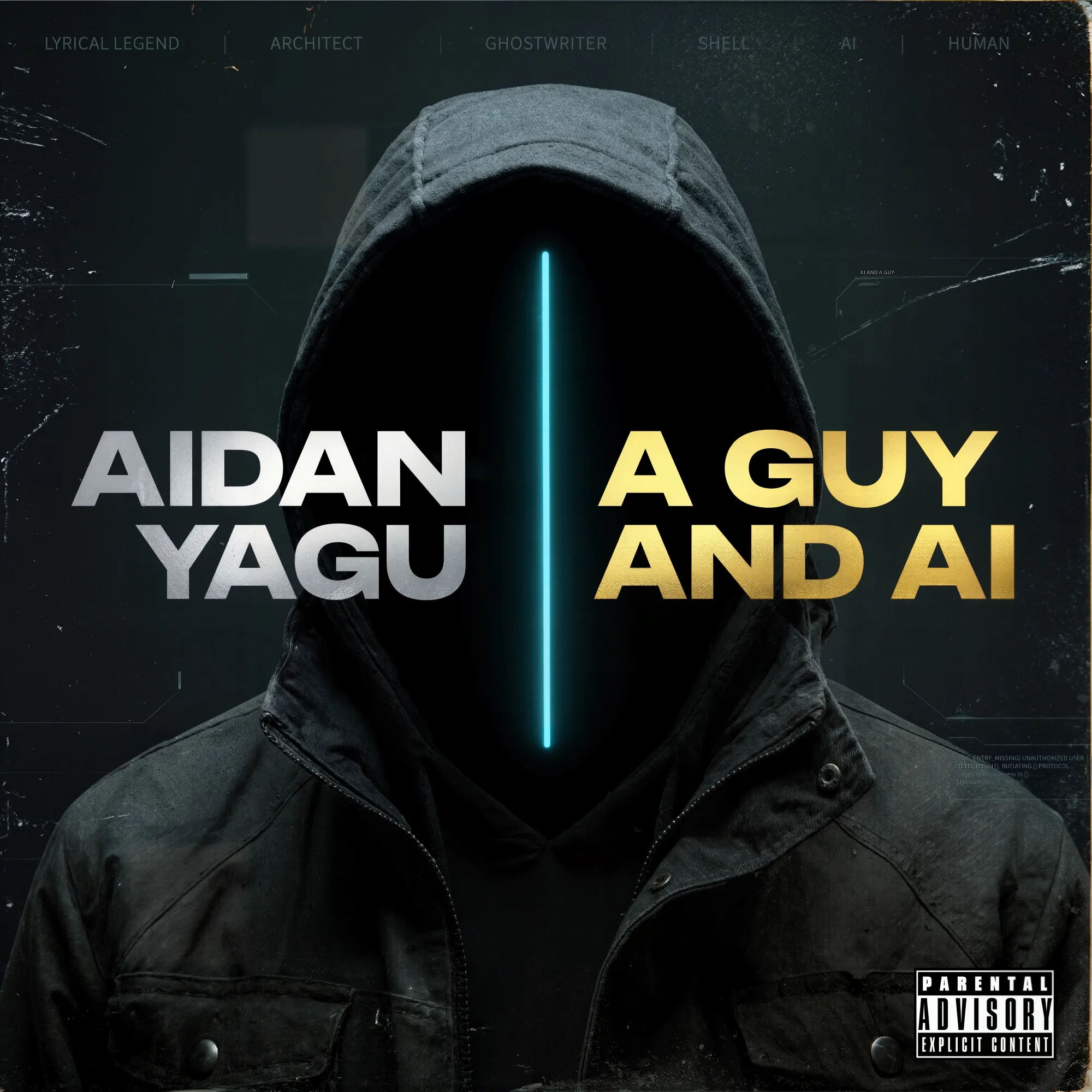
There's a specific thought that visits me at around 2am, usually after I've finished something I'm genuinely proud of. It goes something like this: what if I'm just good at prompting? What if the thing I just made isn't actually mine in any meaningful sense, and the version of me that feels satisfied right now is running on a self-deception I haven't fully identified yet?
I'm going to guess that if you make AI music, or AI art, or AI anything, you've had a version of that thought. Maybe you still have it regularly. Maybe it shows up when someone compliments your work and instead of just accepting it, your brain immediately starts cataloguing all the reasons the compliment is undeserved. The machine did this. I just typed some words. Anyone could have gotten here.
I've been sitting with this long enough that I wanted to actually understand it. So I went looking for the research - and what I found is that what we're experiencing has a name, a documented mechanism, and a specific modern variant that actually didn't exist before generative AI came along. None of that makes the feeling go away. But understanding what's actually happening - and more importantly, where the analysis breaks down for people like us specifically - changes how you hold it.
Before I go further I want to draw one line clearly, because the broader AI conversation tends to collapse two very different things into one. There's the fear of AI replacing your livelihood - the professional artist, the designer, the session musician, the copywriter whose income depends on skills that generative tools are now commoditizing. That's a material, economic anxiety and it deserves its own serious conversation. Then there's what I'm mostly talking about here: the creative legitimacy question - does the work I make with AI tools count as genuinely mine, regardless of whether it pays the bills. For some people those are the same problem at the same time, and that's an especially hard place to be. But for a lot of us in AI music communities this is about a creative outlet, a second life, something we do because we need to make things. Collapsing the two can make the creative question feel more existential than it needs to be - and can accidentally minimize the very real economic fear that other people are living with. Both deserve honest treatment. But this piece is primarily about the first.
The original phenomenonThe Fear Has Been Documented Since 1978
Clinical psychologists Pauline Rose Clance and Suzanne Imes first described the impostor phenomenon in a 1978 paper based on research with over 150 high-achieving women - faculty members, medical professionals, students with documented academic excellence. Despite every external indicator of competence, these individuals maintained a persistent internal belief that they were intellectual frauds who had somehow fooled everyone around them, and that it was only a matter of time before they were found out.
The core mechanism is a distorted attribution pattern. A person without impostor syndrome attributes their successes to ability and their failures to external factors - the task was hard, the timing was off. A person with impostor syndrome does the exact inverse: every success gets attributed to luck, timing, extreme effort, or the audience's poor judgment. Every failure gets attributed to inherent inadequacy. The result is a closed loop that no amount of external validation can break, because the syndrome's architecture specifically routes all positive evidence through a filter that disqualifies it.
"I have written 11 books, but each time I think - uh-oh, they're going to find out now. I've run a game on everybody, and they're going to find me out."
- Maya Angelou, on her own chronic impostorismDecades of subsequent research have confirmed that the phenomenon affects people across all genders, fields, and demographics - with prevalence rates in reviewed studies ranging from 9% to 82% depending on the population and diagnostic method used. A 2020 meta-analysis by Bravata et al. in the Journal of General Internal Medicine reviewed 62 studies with over 14,000 participants and found the pattern consistent and cross-cultural.
In creative fields specifically, impostor syndrome tends to manifest through a different route than in STEM or medical environments. In objective disciplines, the fear is of being exposed as technically incompetent against a measurable benchmark. In creative work, there is no objective benchmark. The fear is more existential: of being exposed as fundamentally unoriginal, emotionally shallow, or uninteresting. Because creative validation relies almost entirely on subjective reception, any praise can be explained away as bad taste, a cultural trend, or the audience simply not knowing any better. The loop is the same. The ammunition it uses is different.
The AI-specific problemThey Actually Studied What Happens to Us
Here is where it gets specific to our situation - and where the research produced a finding I want you to read carefully, because it explains something you've probably felt without having the language for it.
A research team led by Fiona Draxler, published first as an arXiv pre-print in 2023 and then formally in ACM Transactions on Computer-Human Interaction in 2024, ran two empirical studies examining how people experience ownership when they use AI to generate text. The finding they named the "AI Ghostwriter Effect" is this: participants actively used AI to produce high-quality output, publicly declared themselves as the sole authors of that output, and privately did not consider themselves the owners or authors of what the AI had generated.
Both things simultaneously. Public claim. Private disavowal. The exact psychological architecture of impostor syndrome - claiming credit for something you internally don't believe you earned - manufactured by the tools themselves, structurally, regardless of how good the output is.
The caveat in the research is the part that stings most: even when the AI output was highly personalized to the individual user's voice, style, and data, it didn't meaningfully increase their sense of ownership. The only thing that increased ownership was when users exerted significant manual effort on the output after generation. The effort is what triggers the psychological mechanisms that make something feel like yours. Without the friction, the work is commercially viable but internally unclaimed. You can sell it. But you still can't quite believe you made it.
In 2023, researcher Nicholas Caporusso introduced the formal term "Creative Displacement Anxiety" to describe the cluster of psychological responses that AI-assisted creators experience - intersecting technostress, classical impostor syndrome, cognitive dissonance, and economic anxiety. A 2025 study by Ka Yan Chung and colleagues then built and validated a proper measurement scale for it, isolating seven distinct dimensions from data gathered across creative industry professionals.
Source: Chung, Ma & Chan — Creative Displacement Anxiety Scale Development and Validation, IASDR 2025
Now here's the finding that gave me a bit of pause when I read it. In the statistical validation of this scale, the HTMT ratio - a measure of how distinct two psychological constructs actually are from each other - between dimension six (Loss of Identity) and dimension seven (Impostor Syndrome) came out at 1.026. For the uninitiated: In statistical modeling, a ratio above 0.90 means you've lost discriminant validity. In other words, the two things are so overlapping they're functionally the same thing. Which means the research is telling us something significant: for the AI-assisted creator, losing independent authorship to a machine and feeling like an impostor are not two separate experiences. They are the same experience. The researchers put it like this: To lose sole authorship to a machine is to lose the creative self entirely.
The double bindDisclose or Don't - Both Hurt
So you're already battling the feeling internally. And then the external situation hands you a choice that makes it worse either way.
If you tell people you used AI, studies show their emotional connection to the work drops. Not because the work changed - the exact same track, the exact same words - but because their perception of the effort behind it changed. Audiences aren't just evaluating what they hear. They're evaluating what they imagine it cost you to make it. The moment they know a machine was involved, the perceived cost goes down, and the emotional value they assign follows. You were honest. The work is now worth less to them.
If you don't tell them, they connect fully. The praise arrives. People feel things. And none of it helps, because deep down you know the praise is landing on a version of the story that isn't complete. Now get this: Researchers actually have a term for this - "synthetic intimacy." The connection feels real to them. But you're receiving validation for something you haven't fully claimed as yours. The loop doesn't break. It tightens.
There's no clean exit from this right now. The cultural consensus on what makes creative work "earned" predates AI by centuries and it isn't updating quickly. But I think the way through isn't to wait for the consensus to change - it's to ask whether we're framing the whole thing wrong.
Why the likes don't helpA Million Streams and You Still Feel Like a Fraud
I've noticed this in myself and in pretty much every AI creator I talk to: the numbers going up and the feeling getting worse can happen at the exact same time. More views, more follows, more engagement - and somehow the internal voice gets louder, not quieter. That sounds like a personal problem. It's actually a structural one.
Regular listeners and professional peers - other creators, critics, people who actually make the kind of thing you make - are using completely different criteria when they look at your work. Regular listeners respond to how something makes them feel. Peers look at how you got there. Two different conversations about the same piece of work, happening simultaneously, and only one of them addresses the thing you're actually anxious about.
AI is very good at generating output that satisfies the first conversation. A well-directed prompt can produce something emotionally resonant, technically polished, and perfectly engineered for the platforms. Thousands of plays are genuinely achievable. But sociological research on creative reputation going back decades shows that lasting legitimacy doesn't come from popular reception - it comes from peer recognition. The million people who love your track aren't having the conversation that would quiet the impostor. The one creator who genuinely respects your process is. And in the AI music space, that person is harder to find - because most of your peers are in the exact same loop you are.
Where the research gets it wrongThey Studied Students. We're Not Students.
Almost all the research on AI and "unearned capability" - the idea that AI hands people output they didn't develop the skills to produce - is based on students. Young people using tools to bypass developmental stages they haven't reached yet. And the findings are real: their output outpaces their internal growth, they feel guilty and disoriented, they can't defend the choices they made because they don't fully understand them.
That's a real problem. It's just not our problem. And I think conflating the two is part of why so many of us in this community are applying a framework to ourselves that was never designed to fit our situation.
Victor Yocco, writing in UX Matters in 2026, described what he called "algorithmic learned helplessness" - the point where creators stop trying to shape the tool and start letting the tool shape their vision instead. That is worth being afraid of. That's a real thing that happens when you stop caring about what you're saying and just optimize for what the machine produces easily. But the antidote isn't to doubt the capability. It's to keep the intent yours.
A Xennial who spent twenty years accumulating life experience - grief, failure, complicated relationships, a whole inner world that never had an output - and then found a machine that could finally give it form... that's not unearned capability. That's previously undeliverable capability. The experience that justified it was always there. The tool just opened the door. And the difference between those two things is the difference between an impostor and someone who was just waiting for the right instrument.
The actual answerStop Trying to Be Relatable
Here's the thing I've decided for myself - and it took me a moment to get here, so I'll say it plainly. The question "does this count as real art" is the wrong question. Not because it's unfair, but because it's answering to the wrong audience. It's asking the gatekeepers whether your work meets their criteria. And their criteria are built without us in mind.
The better question is: does this tell someone something true about who you are?
A story doesn't have to be relatable to be real. Most of the art that has ever mattered to anyone wasn't universally relatable - it was specific. It was one person's particular experience, told with enough honesty that it made other people feel less alone in their own particular experience. That specificity is the thing. Not the polish, not the platform performance, not the technical process. The specificity of what you were actually trying to say, and whether you had the courage to say it without softening the edges to make it more digestible.
I can feel the difference when a track gets there. I keep talking about frisson. You could also just call it "knowing". And it only happens when I believe the experience behind the words I hear is genuinely in them, not just described by them. Obviously this is much easier to achieve on my own tracks ...but I do get the reaction from others as well, once in a while. That's the only quality control that matters to me. Not because it's a perfect system - but because it's the one thing the impostor syndrome can't access. It doesn't fire when I'm acting. It fires when I'm telling the truth.
I'll be transparent about something here since this whole piece is about honesty: I use AI extensively for scaffolding this blog. Especially the research via Gemini Deep Searches, I use Notebook LLM to get an idea of structure, organizing all assets, finding connections between ideas I haven't fully articulated yet. It's a huge part of how I work and I'm not shy about that. But the writing - the actual sentences, the voice, the specific way I choose to say something - that's mine. That distinction is the whole point of everything I've argued above, and I'd be a hypocrite not to name it in a piece about creative legitimacy. The scaffolding is AI. The building is me.
None of this means the work is finished. We're all a work in progress - not just the art, but us. Every track I make is a step further into understanding what I'm actually trying to say and how to say it. Some of them get closer than others. Some of them I look back at and hear exactly where I was pulling punches. That's fine. That's the process. The impostor syndrome wants you to believe that not being there yet is proof you were never real. It isn't. It's just proof you're still going.
The AI Ghostwriter Effect is real. Psychological ownership does require effort and intention - the research on that is solid. The answer isn't to dismiss it but to take all this seriously. If you want to combat that feeling, go and keep your hands in the work, write your own words, make the choices that require you to actually have a perspective. Use the machine for execution. But keep the authorship. Not as a moral position - just as the only way it ever genuinely feels like yours. And give yourself time. The voice gets clearer. The work gets more honest. We're all still figuring it out.
Cheers,
Aidan